Thursday, February 23, 2012

Case Study No. 0256: Callimachus

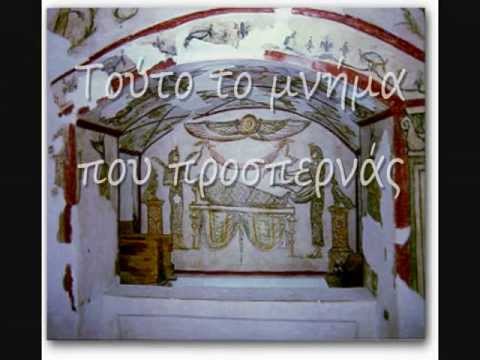
Epigram on the tomb of Callimachus of Cyrene
0:54
http://melidonismata .blogspot.com/ 2011/10/ on-tomb-of- callimachus.html
Tags: Callimachus Cyrene Libya ?????????? ?????? Poetae Novi
Added: 3 months ago
From: MelidonisM
Views: 64

This tomb you pass by
belongs to Callimachus from Libya
He knew to sing well
as long as red wine was inside the cups
on the rhythm, with the companions
He laughed

Epigram on the tomb of Callimachus, Hellenistic poet from Cyrene, who worked at the Library of Alexandria, Egypt. 10/305-240 BC

Music/Translations, Michalis Melidonis

Image crediting at melidonismata .blogspot.com/ 2011_10_01_archive.html

---

From duke.edu:

CALLIMACHUS (c.305-c.240 B.C.)

Ancient Greek poet, librarian, and scholar, famous representative of the sophisticated Alexandrian school of poetry. Callimachus' most famous prose work is the Pinakes (Lists), a bibliographical survey of authors of the works held in the Library of Alexandria. It is said to have comprised 120 books.

Little is known of Callimachus' life and only fragments of his writings have survived. He was born in Cyrene, North Africa, into a prominent family. Callimachus called himself Battiades, "son of Battos," who was the mythical founder of Cyrene. "You're walking by the tomb of Battiades, / Who knew well how to write poetry, and enjoy / Laughter at the right moment, over the wine." ('On Himself', in The Greek Anthology, 1973, trans. by Peter Jay) Callimachus also tells, that his grandfather was a general.

After possibly being educated in Athens, he migrated to Alexandria. A number of sources say that he taught at an elementary school in Eleusis, a village outside the town, but according to Alan Cameron, this is not likely: to call somebody an elementary teacher was actually an insult in both Roman and Greek times. (Callimachus and His Critics, 1995) A member of an influential Cyrenean family, Callimachus was presented to King Ptolemy II Philadelphus (282-246 B.C. ). He become a "court youth" and later joined the Museum. It was a kind of institution of arts and sciences, founded by Ptolemy I (305-282 B.C. ), called the Soter, "the Saviour". Ptolemy was a friend of Alexander the Great, and a historian. He wrote an account of Alexander's campaign of conquest.

The Library of Alexandria was the most important in the whole Hellenistic culture and contained the greatest collection of texts. It is believed that the library held hundreds of thousands of scrolls at one time. Its first director, Zenodotos, began an inventory of the scrolls acquired by the Ptolemies for the Museum. They had sent agents to different parts of the Greek world to buy books - everything was good enough for the collections, even a book called Everything Thucydides Left Unsaid, written by the scholar Cratippus. Whenever a ship unloaded at Alexandria, it books were copied, and the originals went to the library (or sometimes back to the owner). Among its treasures was Aristotle's collection of books. The library consisted of two separate sections. The greater, part of the royal palace, was said to house nearly half a million scrolls. The lesser, attached to the Temple of Serapis, stored about forty thousand. The dimensions of a scroll were small, Homer alone took up at least 24 scrolls for the Iliad and the Odyssey. Callimachus separated the longer works by having them copied into several shorter sections. It has been suggested that Callimachus was in charge of the library after Zenodotus, although Eratosthenes (234-195 B.C. ) is more often mentioned as his successor - Eratosthenes measured the north-south circumference of the Earth with great accuracy.

There, at the Museum, Callimachus' major achievement was Pinakes ton en pase paideia dialampsanton kai hon synegrapsan (List of those who distinguished themselves in all branches of learning, and their writings). Pinakes is catalogue of Greek authors and their works, along with biographical and literary information. It has not been preserved and most likely Callimachus did not complete his gigantic work - cataloging, once it started in the ancient times, has never ended in libraries. The first biobibliography to appear in print dates much later - it was Johannes Trithemius's Liber de scriptoribus ecclesiasticis (1494).

---

From google.com:

Following Alexander's death in 323 B.C., his conquered lands were divided among five Macedonian generals, one of whom, Ptolemy Soter (Ptolemy I), was given Egypt. Ptolemy had great respect for learning and he encouraged scholars to immigrate to Alexandria, which became a center of culture and learning. Ptolemy and his son Ptolemy Philadelphus (Ptolemy II), with the help and encouragement of Demetrios of Phaleron, founded the Alexandrian Museum and Library. The mission of the library was ambitious - to collect the entirety of Greek literature. To accomplish this, the founders went to great and sometimes questionable lengths. The Alexandrian, like the library of Ashurbanipal before it, aggressively collected materials throughout the known world. In addition, Ptolemy frequently confiscated cargoes of books in ships that came to Alexandria. Copies were made of the originals and the copies were returned to the ships.

The collected items were subsequently organized and edited, and many were translated into Greek. The collection was stored in two buildings: a major structure called the Brucheion, which was used for research, and a smaller library called the Serapeum, which might have provided some service to students and the public. The Brucheion was divided into ten great halls, each hall representing a separate area of learning. There were also some smaller rooms for individuals involed in special studies.

The Alexandrian was also notable for its librarians, many of whom achieved great personal fame, such as the scholar Callimachus. According to some historians, under Callimachus's guidance, the library exceeded more than a half-million items, although the actual size of the collection relies on various accounts of questionable authenticity. Callimachus is especially known for his subject catalog of the library holdings, called the Pinakes, which contained 120 scrolls arranged into ten subject classes. Within each class, there were subdivisions listing authors alphabetically with titles. Because some entries included historical or critical remarks, some historians regard the Pinakes as more than a catalog, suggesting that it might have also served as a history of Greek literature.

Wednesday, February 22, 2012

Case Study No. 0255: Fishstick Librarian

The Librarian
5:54
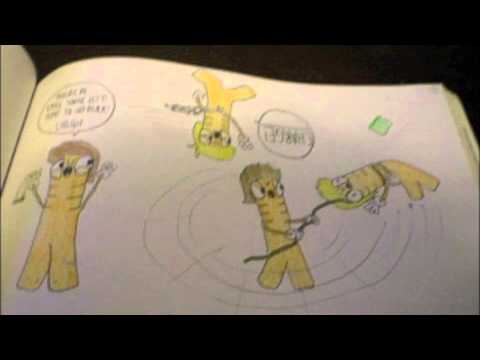
A group of friends joined together in a squadron by the name of alpha squad have enter the school mostly frequently avoided place... the library! After planning to blow the library up (just because it is a library) using a computer virus, the alpha squad face a mighty beast... The librarian.
Tags: The Adventures of Fishstick Guys
Added: 1 year ago
From: fishstickguy1
Views: 19

"The Adventures of Fishstick Guys"
New Project 1 - The Librarian

[the first panel shows a closeup of a female librarian sitting in the school library, as someone from off camera points at her]
ALPHA SQUAD FISHSTICK 1: [from off camera] Ooh, what is that?
ALPHA SQUAD FISHSTICK 2: [from off camera] Maybe a monster!
ALPHA SQUAD FISHSTICK 3: [from off camera] An ogre!
ALPHA SQUAD FISHSTICK 4: [from off camera] An alien!
ALPHA SQUAD FISHSTICK 5: [from off camera] A what?
[the second panel shows the Fishstick Alpha Squad leaping into action and entering the library]
ALPHA SQUAD FISHSTICK 1: Let's go Alpha Squad! Go go go go!
[one of them stops as he drops his bag of weed]
ALPHA SQUAD FISHSTICK 2: Oh no!
ALPHA SQUAD FISHSTICK 3: Ha ha!
[the third panel shows the clumsy fishstick as he kneels down in front of the bag and starts crying]
ALPHA SQUAD FISHSTICK 2: My poor baby, breathe!
ALPHA SQUAD FISHSTICK 1: To the computers!
[the fourth panel shows the distraught fishstick putting a noose around his neck, as the other members of the Squad gather around a table]
ALPHA SQUAD FISHSTICK 2: This rope is extremely tight, yay! My weed packet would have wanted it this way ...
[in the background, a fishstick patron stops playing his Nintendo DS and punches another fishstick sitting at his table]
FISHSTICK PATRON: You son of a bitch! You killed my Pikachu!
ALPHA SQUAD FISHSTICK 1: Hurry up! These trojans are going down!
[the fifth panel shows the suicidal fishstick hanging lifeless from the library's ceiling, as two of his brethren stare at him and poke him with a stick]
ALPHA SQUAD FISHSTICK 3: We must not let his body go to waste. Let's harvest his organs, because I forgot to bring my lunchbox!
ALPHA SQUAD FISHSTICK 4: He's dead.
[the leader ignores the suicide and is typing at one of the computers]
ALPHA SQUAD FISHSTICK 1: Once I upload this trojan horse virus, this whole library is going down!
[the sixth panel shows the other Squad members continuing to poke the dead body, as the leader finishes typing at the computer]
ALPHA SQUAD FISHSTICK 3: Wanna use his body as a pinyata?
ALPHA SQUAD FISHSTICK 1: The timer has been set!!! Run for your lives!
[in the background, the fishstick patron continues playing his DS as the other fishstick's stabbed body lies on the table]
FISHSTICK PATRON: Drink this potion, Pikachu. You will feel better, hee hee!
[the seventh panel shows the Fishstick Alpha Squad fleeing the library as the computer timer counts down from eight seconds]
[the eighth panel shows the leader jumping on a scooter when he notices the librarian chasing them]
ALPHA SQUAD FISHSTICK 1: He's onto us! Run!!! Or ride ...
ALPHA SQUAD FISHSTICK 3: [throwing a bong in the air] There's a pink elephant chasing me!!!
FISHSTICK LIBRARIAN: Oi, you, stop! What were you doing on that computer?
[the ninth panel shows the librarian throwing a book at them, entitled "How to Read a Book"]
ALPHA SQUAD FISHSTICK 1: Oh no, books! My only weakness!!! Ahhh!
[the tenth panel shows the book slicing right through his stomach, as the librarian throws two other books ("How to Enter a Womb" and "How to Exit a Womb") at another Squad member who is bending down to pick up the bag of weed]
[another Squad member is hanging from the ceiling and looking at the carnage below]
ALPHA SQUAD FISHSTICK 4: Why are those idiots walking on the ceiling?
[the eleventh panel is a closeup of the Squad member picking up the bag of weed]
[the twelfth panel shows the Squad member opening the bag, while another member grabs his suicidal teammate's dead body by the noose and starts swinging it around in an attempt to strike the librarian]
ALPHA SQUAD FISHSTICK 3: There is still some left! Time to go Hulk! Urgh!
[the Squad member hanging from the ceiling cheers on his teammate]
ALPHA SQUAD FISHSTICK 4: Charge!
[the thirteenth panel shows the weed user turning green from the effects of the drugs, while the guy hanging from the ceiling uses his heat vision to burn the books being thrown at him by the librarian]
ALPHA SQUAD FISHSTICK 3: Aaah!!!
[the fourteenth panel shows the drugged-out Squad member hallucinating (with three arms and multiple eyes)]
ALPHA SQUAD FISHSTICK 3: I'm trippin' out!!!
[his teammate karate kicks a stack of books nearby]
ALPHA SQUAD FISHSTICK 4: Hi-yah!
[the librarian urinates herself at the sight of this violence]
FISHSTICK LIBRARIAN: What the &@%# is that!
[the fifteenth panel shows the drugged-out Squad member convulsing on the floor of the library, with one of his teammates sitting in a chair and calmly reading a book]
ALPHA SQUAD FISHSTICK 5: Are you guys finished playing?
ALPHA SQUAD FISHSTICK 3: Kill me ... please ... urgh ...
[in the background, the librarian hits one of the Squad members over the head with a book entitled "World's Dullest Encyclopedia"]
[the sixteenth panel shows the librarian standing over the defeated body of Fishstick 4, covered in blood]
FISHSTICK LIBRARIAN: Yes, I win again!
[in the background, one of the Squad members is putting a lighter to The Holy Bible]
ALPHA SQUAD FISHSTICK 5: I'm gonna get bashed for this ...
[the seventeenth panel shows the supposedly defeated Squad member standing up and wiping the "blood" off of himself (which turns out to be from a ketchup bottle)]
ALPHA SQUAD FISHSTICK 4: Stuff it! I'm not getting paid enough for this act ... I quit!
FISHSTICK LIBRARIAN: [still celebrating] Everybody dance now ... bump bump bump!
[in the background, the infected computer is still beeping]
[the eighteenth panel shows a closeup of the librarian (with bugs in her hair) suddenly acting afraid]
FISHSTICK LIBRARIAN: Oh no, they must of set a virus!
[the nineteenth panel shows the library disappearing in a "BOOM!" graphic, as the librarian runs away]
FISHSTICK LIBRARIAN: Aaaaaaa Aaaaaaaaa Aaaaaa Aah!
[a lone turtle crawls away from the wreckage]
TURTLE: Run for your lives, man!

Produced by DKomics
Drawn and spoken by Dylan Kars

Case Study No. 0254: "Terrorist librarians"

Terrorist Librarians - The Patriot Act in Action
8:58
Part one of two. David Goodman describes how a group of CT librarians fought the unlimited power of the Patriot Act. Amy Goodman and brother David on book tour.
Tags: David Goodman patriot act civil rights obama rocks
Added: 3 years ago
From: jaytrebledotcom
Views: 299

[David Goodman is standing at a podium and speaking to the audience]
DAVID GOODMAN: One of my favorite stories in our book has to do with some of the most fearless and tenacious freedom-fighters that you'll find anywhere in our country. Uh, these are people who you would not wanna meet in a dark alley if you were trying to hijack someone's civil liberties. And of course, I could be speaking about no one else than our nation's librarians.
[laughter from the audience]
DAVID GOODMAN: Amy and I travelled to Connecticut to meet four librarians, uh, who have had quite an impact in the actions that they took. And if anyone embodies the notion of people who, uh, were not looking for trouble, have never been in trouble ... it would be these four librarians. Around Hartford, the capitol of Connecticut, are 27 libraries who decided to link together their computer systems to put their heads together. And so when people go to the public library to surf the net and do email, which is a big use that the library offers, a big service libraries offer nowadays. So anyway, their computer systems are all linked together and run by a small cooperative organization called the Library Connection. Well, one day George Christian, the executive director of the Library Connection, has a small professional staff and volunteer librarians who manage this operation. So, one day George Christian is sitting in his office, when there's a knock at the front door. Uh, there's two gentlemen there who wanna see the boss. And these two men identify themselves as special agents from the FBI Hartford office. They have a letter for him, but this is no ordinary letter. It is called a National Security Letter, or NSL. And upon opening it, it's like Superman opening kryptonite, or getting handed a radioactive rock, because the moment you open this letter and read its contents, you are immediately bound to do what it tells you and gagged from speaking to anybody else. And so the agents direct him to read the letter in their presence, it's very short. It informs him that the FBI wants information on every single person who's used the library computer system in all 27 libraries on a particular day that was four months before.
[murmurs from the audience]
DAVID GOODMAN: Um, it offers no particular reason, other than that the FBI is seeking this information in a national security case. It informs him that he must comply with this order, he must not tell anyone that the FBI is investigating him, and should he break this gag order he will be subject to five years in prison. And they have him read that line about "You cannot tell anyone," pointing to each word the way a childrens' librarian might point, underline, while reading at story hour. He looks at this, and he looks at these burly agents in front of him, and he says "I believe this is unconstitutional, and I'm not going to give you anything that you're asking for." So the agents look at him in the way that a predator kind of looks at its prey just before tearing it to pieces, that kind of pitying head-shaking way, and they say "Well, you get back to us just as quickly as possible, then." And they leave him with a business card. So, after playing Superman for a few minutes there, George shrinks back in his office, collapses into his chair, and wonders what on earth he is going to do. He doesn't even know if he can call a lawyer, from the way this thing is worded. It says "You cannot tell anybody." And of course, that ambiguity is exactly what the government intends. It's this all-powerful omnisicent sense, "We are watching, we are controlling." So George decides, well, he can't fight this alone. The only people who can take on the full might of the National Security state ... it'll take at least four librarians to do that.
[laughter from the audience]
DAVID GOODMAN: And so, he calls the executive committee of the Library Connection, which is three other librarians who volunteer for this job, one of whom told us how he came to be on the executive committee. Peter Chase, the very polite mild-mannered director of the Plainville Public Library in Connecticut, tells us "Y'know, I'm very busy with my library and I got this call from one of my colleagues, they said 'Peter, please won't you be on the Library Connection board for the next year? We're gonna give you a fancy title, we're gonna call you Vice President, it'll be really easy.'" Two weeks later, Peter Chase is in a pitched battle of national implications, gagged from speaking to anyone in his community or in his family, and the fight is on.
[laughter from the audience]
DAVID GOODMAN: So, uh, George Christian calls this emergency meeting of the executive board. This has never happened in the history of this organization before. Uh, and these librarians, it's a very cryptic message, "We must meet immediately tomorrow morning, I can't tell you what it's about, it's an emergency." So Peter Chase is driving there and thinking, "What could this be? Overdue books? An adult book that was filed mistakenly in the childrens' section?"
[laughter from the audience]
DAVID GOODMAN: I mean, he's rifling through everything a librarian would normally worry about. Um, they arrive at this meeting, and George Christian pulls out this letter. And once again, by opening it, everybody in the room is exposed and they're all bound to it and gagged. Their little nonprofit lawyer, who does pro bono work for the librarians, gets up and basically flees the meeting, realizing she is in way way over her head, and recommends that they call the ACLU. So they do, and the ACLU national office decides to handle the case, because as it turns out, our nation's mild-mannered librarians have actually been itching for a fight to take on the PATRIOT Act. They knew they were gonna take it up somewhere, they just didn't know exactly where. Uh, and certainly these librarians in Connecticut didn't know ...

---

From libraryjournal.com:

Standing Up to the Madness
April 29th, 2009

"Standing Up to the Madness: Ordinary Heroes in Extraordinary Times", by Amy Goodman and David Goodman, is a must-read for every librarian, since it details the now famous story of "four Connecticut librarians who refused to spy on their patrons, challenged the USA PATRIOT Act, and won."

Old news? Perhaps, since it happened in 2006, but if you want to get a mega-shot of pride in our profession, take a look at this recent video of David Goodman describing the story.

---

From democracynow.org:

Chapter 3, "Librarians Unbound"

Few Americans understand how draconian the PATRIOT Act is unless it reaches out and touches them. When the four Connecticut librarians received a national security letter, they were shocked to learn that it stripped away civil rights that they thought were inviolable.

"Where is the court order?" Chase asked George Christian.

"There is none," replied Christian. "They said they didn't need one because they had an NSL." The librarians were being ordered to turn over records on their patrons simply because an FBI agent told them to.

"All of us, as law-abiding citizens, understand that when there's a subpoena, and there's judicial oversight of the process in the course of an investigation, library records may be subpoenaed," said Alice Knapp, president of the Connecticut Library Association and director of public services at the Ferguson Library in Stamford. "But what is of the utmost concern to people is the lack of oversight [in the PATRIOT Act]. And that it can be used for a fishing expedition."

Chase explained, "For us, this is a very important principle. A court order protects you because you have a neutral third party - the court - and you must convince them that a crime has been committed. People come to us and say very confidential things to our reference librarians - they have medical issues, personal matters. What people are borrowing at a public library is nobody's business."

For librarians, safeguarding the privacy of their patrons is a sacred trust. Chase recounted how local police once came into the Plainville Public Library alleging that a driver in a nearby hit-and-run car accident had just come from the library. The police demanded to know who had borrowed books that afternoon so that they could identify potential suspects. "I told them to get a warrant," said Chase, whose politeness belies his steely determination. "They were not happy with me, but that's okay."

As for the cops? "They didn't get the information."

The Library Connection attorney said that the only way to avoid arrest was to either give the FBI the information it wanted, or sue the attorney general of the United States. The librarians quickly realized that they had been snared in a cynical trap. "We were well aware that Ashcroft actually said we were being 'hysterical' because [the government] was not using the PATRIOT Act against libraries," Chase told us. "So what are we supposed to do - actively participate in this deception? It was not bad enough we had to watch this. Now we had to join in."

For Connecticut's mild-mannered librarians, there was no hesitation about how they would respond to this attack on the privacy of their patrons: They would fight like hell.

---

From npr.org:

George Christian, Peter Chase, Barbara Bailey and Janet Nocek were four Connecticut librarians who were ordered not to discuss an FBI demand for patrons' records. They resent the fact that they were forbidden to speak while Congress was debating the issue as part of the renewal of the USA Patriot Act.

The gag order on the librarians was issued under what's known as a National Security Letter -- an administrative subpoena for records that the FBI can issue without prior court approval.

Librarians challenged the gag order with the help of the American Civil Liberties Union. But before the lawsuit was fully litigated, prosecutors dropped their appeal, leading a judge to rescind the gag order on the librarians. Nonetheless, analysts say the gag-order option remains available for the government in future cases.

Case Study No. 0253: Nancy Wagner and Elizabeth Hamilton (student library workers)

Electric Wizard - Dunwich
1:47
Track #2 off 2007's "WitchcultToday" Album. Video clip from the 1970 film, The Dunwich Horror which was based off of H. P. Lovecraft's short story by the same name.
Tags: Electric Wizard Dunwich Witchcult Today Doom Stoner Rock Metal Psychedelic
Added: 1 year ago
From: BloodstormGMA
Views: 280

From earthlink.net:

THE DUNWICH HORROR

Haller, Daniel (Director). The Dunwich Horror. United States: American International Pictures, 1970.

Starring: Toby Russ (Librarian??); Sandra Dee (Nancy Wagner); Dean Stockwell (Wilbur Whateley); Ed Begley, Sr. (Dr. Henry Armitage)

Based on the Short Story: Lovecraft, H.P. "The Dunwich Horror." Weird Tales, 1929 http:// www.dagonbytes.com/ thelibrary/lovecraft/ thedunwichhorror.htm

Although actor Toby Russ is credited as playing the librarian at the Widener Library, multiple screenings of this film failed to identify him, and I wonder if he didn't end up on the cutting room floor. In Lovecraft's story, Dr. Armitage is a librarian, although this is not evident in the film (his Necronomicon being on display in the library notwithstanding ... many if not most library exhibits are owned by outsiders). The two young ladies (the Sandra Dee character and her friend Elizabeth, invented for this film) who handle the book and discuss the library's imminent closing may or may not be associated with the library itself. One reviewer refers to Miss Wagner as "the beautiful librarian." Acknowledging Armitage as a librarian, he certainly obstructs the flow of knowledge, but for a good reason, if one believes peace and sanity of the world is a good reason. In any case, two brief library scenes (one features a fight, if you're keeping track of libraries as settings for violence) and no apparent librarian make this film of little interest to the profession, but if you're old enough to remember the 1970s or are a Dean Stockwell fan, it's a hoot to watch. If you're a Lovecraft fan, forget it.

---

From google.com:

"The Dunwich Horror" (1970) focuses on Wilbur Whateley (Dean Stockwell) and his attempt to bring back "the old ones, princes of darkness" so that they can "repossess the Earth." To do this, he needs a book (Necronomicon) and a young virgin. He visits a nearby university for the book and also finds librarian Nancy Wagner (Sandra Dee), the perfect young woman for his work. As the film opens, students Nancy and Elizabeth Hamilton (Donna Baccala) are returning the Necronomicon to the university library where they work. They meet Wilbur, who asks to use the book. Elizabeth rejects his request, "That's impossible." She is adamant about refusing Wilbur access to the book and buttresses her decision by declaring, "The library is closing."

Nancy, however, permits him to take the book into a nearby reading room. As the two students discuss the pros and cons of permitting Wilbur to use the book, Nancy remarks, "Did you notice his eyes? He's really got great eyes." Elizabeth, worrying about Nancy's decision to give the priceless book "to the first kook who comes along," is rebuffed by Nancy, "I trust him."

Dr. Henry Armitage (Ed Begley) soon returns and takes the book from Wilbur, and after a brief discussion with Wilbur, he tells the two students, "It's easy to see why you two girls were effectively charmed." The four leave the library for an enjoyable dinner, and Nancy drives Wilbur back to his home in Dunwich, where she falls under his spell. Nancy is rescued during the closing minutes of the film.

Both students are young and attractive - Nancy, a blonde (bouffant; ponytail at nape), wears a black turtleneck sweater and pleated camel skirt; Elizabeth, a brunette (front and sides pulled up into ponytail at crown; back hangs in page), has on a white blouse with an open convertible collar and a dark pleated skirt. The only library-related task they undertake is putting the Necronomicon back into its glass-enclosed case, which they immediately reopen to give to Wilbur. This brief scene permits filmgoers to easily identify the two students as librarians.

Tuesday, February 21, 2012

Case Study No. 0252: Unnamed Female Librarian (The Book 2)

The Book 2: Revenge of the Librarian
1:26
Sequel to the first one.
And sorry, though this is a movie trailer, there will never be an actual movie.
This was a project for school.
Same concept of the first one.
Student steals book, librarian gets mad.
Librarian gets injured.
:)
Tags: librarian library student steal books revenge classroom school
Added: 2 years ago
From: Ekhm92
Views: 228

[scene opens as a male student walks into class with a black eye]
GIRL: What happened?
BOY: The librarian hit me!
[cut to a black and white scene from the first film, where the librarian hits him in the face with a giant atlas, then back to a closeup of the boy's face]
BOY: It's time for payback ...
NARRATOR: This summer ...
[cut to a female librarian (with frizzy hair and thick glasses) scanning a book in the school library]
NARRATOR: One boy ...
[cut to a shot of the boy slamming his locker shut]
NARRATOR: Will risk getting bad grades ...
[cut to the boy grabbing a stack of books and hiding behind the front desk, as the librarian looks around]
LIBRARIAN: Where's my books?
NARRATOR: To get revenge!
[cut to the boy taunting the librarian, by waving one of her books at her from the stairwell]
BOY: Want it?
[he throws it down the stairs]
NARRATOR: She'll do anything to stop him ...
LIBRARIAN: My book!
[she climbs over the staircase and falls down]
LIBRARIAN: Aah!
NARRATOR: Though it always ends in pain ...
[cut to the librarian laying motionless at the bottom of the stairs, then cut to the librarian chasing the boy out of the school]
LIBRARIAN: Sir! Gimmee back my book, sir!
BOY: No, I can't!
[she tries to pull the book out of his hands, but loses the "tug of war" and ends up falling backwards]
LIBRARIAN: Aah!
[she reaches for the book, but he kicks her back down onto the ground, then cut to a closeup of her face (with her glasses comically askew) as she loses consciousness]
LIBRARIAN: Ohhhh ...
[cut to several more shots of the librarian in pursuit, including one sequence where the boy slams the door in her face]

Matt C.
Emily M.
Chelsea C.
The Book 2: Revenge of the Librarian
August 5

[cut to the librarian chasing him down a flight of stairs]
LIBRARIAN: Sir!
[she falls down (losing her glasses), as the boy laughs at her and continues running away]

Case Study No. 0251: Miss Morton

Let's Play Amazon: Guardians of Eden - Chapter 3 Bonus
0:19
B.O.B. and the Librarian
Tags: let's play amazon guardians eden
Added: 3 years ago
From: slowbeef
Views: 1,728

From wikipedia.org:

Amazon: Guardians of Eden is a point-and-click adventure video game for MS-DOS from Access Software. It is one of the first games to feature super VGA graphics. Amazon is a movie adventure game about a 1957 expedition into the heart of the Amazon basin, "a desperate, crazed message sends [the player] on a perilous search through a land where legends come to life, danger hides behind every corner, and incredible treasures wait to be discovered."

---

From gamefaqs.com:

SOLUTION TO "AMAZON: THE GUARDIANS OF EDEN"
Access Software 1992

[...]

HEAVY METAL MONSTER
Don't worry. BOB's a pushover. Turn around and walk out of the vault and back to the guardhouse. The bear is gone, the lovers are still making out. Walk back to the garbage can and PICK it UP. Go back into the vault. Goodbye BOB.

Now MOVE the lever and open the doors to the vault. USE the crowbar to open the bottom right drawer. PICK UP the map, compass and microfilm. There's nothing else for you here, so walk out again, through the guardhouse, past the tree stump and back into the research building.

The library is now open. TALK to the librarian (you get nowhere the first time) and keep talking until she tells you she only leaves her post if the lights of her car are left on. Walk back along the corridor toward the outside doors. Go to the coat rack outside your office. PICK UP the coathanger by itself over to the right. Go to the parking lot and USE the coathanger on the librarian's car. Once inside, MOVE the light switch on the dash. Walk back into the building and TALK to the librarian again and tell her the car lights are on. This gets you into the microfilm machine. SELECT the microfilm from inventory and place it in the reader. MOVE the arrows to see all the message, then EXIT. Go back to the parking lot, SELECT your own car keys and USE them to get into your car.

---

From lparchive.org:

Chapter 3: Heavy Metal Monster (an Access Serial)
Jason has the top secret security vault in search of Allen's files. Little does he realize the area is being patrolled by 'B.O.B.' Binary Overseer Biped . This robotic terror is in development for use against the vast commnist hordes who plan the overthrow of the American way of life.
Until that day, this metal titan guards the secrets that keep this country strong....

Okay, so welcome to Episode 3: Heavy-Metal Monster, or as I like to call it: "False Advertising." We get a glimpse of the danger that awaits us...

B.O.B. is patrolling the front of the vault. He's apparently not the best security robot in the world, though, as he's fine with you just standing there in the vault. Walk too close to him...

"B.O.B. has a flaw in his programming that directs him to shoot"

And Jason gets shot. How does B.O.B. shoot him with no visible gun? Why is it listed as a programming fault even though it's actually what B.O.B. is programmed to do? What kind of horrible acronym is Binary Overseer Biped?

Wait, as long as I'm asking the questions, doesn't "Shot Jason" look a lot different from "Imprisoned Jason" and from "Intro Smiley Jason?" And wait - he doesn't get that outfit until later in the game!

The answer to all of these questions is a definitive Fuck You as Access Software just tries to sweep all that shit under the rug. The trick here - believe it or not is to go back outside where the guards are still enjoying their tryst and the bear is just magically gone.

Now take the garbage can and you've solved the puzzle! No, seriously.

"Good morning B.O.B."

Since B.O.B. was developed in the 1950s, I guess it's not so much of a stretch to say you can fool him by putting a trash can on your head. Keep in mind, the game has no concept of "self" to use items on, so if you walk in with the trash can in your inventory, Jason just does this part for you. Which is fine by me, because it's a pretty stupid puzzle.

Anyway, B.O.B. assumes you're taking over his shift (really) and leaves. Even know the chapter is named presumably named after him, that's the last we'll see of it. Jason removes the trash can.

The device on the right is an Introciter. What's that? I don't know, and neither does the game.

"The Introciter sits only partially assembled at the far end of the cavern. This advanced piece of equipment was found in the labs of Dr. Meecham. No one has yet figured out how to make it work."

This isn't a puzzle, or even a red herring. It's just a bit of background that's there for no reason at all. Just pull that lever to open the vault.

The bottom right drawer is the only one that contains anything of interest to you, according to the dialogue boxes. The only problem is: It's stuck closed!

That's okay, because this is a "no-reason" puzzle. You get the crowbar with the bolt cutters from Darlene's trunk - there is no way to take one without the other. You need the bolt cutters to get in here. So, you're guaranteed to have the crowbar which you need for this drawer.

This puzzle, in other words, is solved by an item you are guaranteed to have and is really nothing more than busy work for you to do. Anyway, pry it open to get Allen's "file."

"You carefully remove the map, compass, and the microfilm from the drawer."

You're also not allowed to examine or manipulate your inventory, so there's actually no way to get the game to tell you what this is a map of. Lovely.

Well, that's the end of B.O.B. and the vault, but we've more to do in this chapter. Let's head back inside.

The library - and owner of the third car - is now available. Since she's a huge Slayer fan, that's actually the heavy metal monster we'll be dealing with. We're going to ignore her for now in order to get to Allen's safe.

Behind the dartboard?! Allen! That's like the first spot I looked! Anyway, use the combination (it's an item now) to open it and attain $1000 in cash.

"Now you have everything you need to leave for your search for Allen."

Oops! Actually, we still need to check out the microfilm, so nice try trying to trick me, game!

Also for any of you wondering why I'm not taking the bow, the game informs me that I don't need it. Duh. Blowgun, sure, but a bow is really just ridiculous. Come on.

Well, the only place to get microfilm checked out is the library, so...

"What can I do for you?"

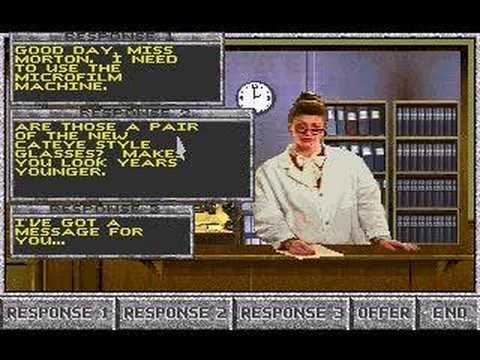
...Cat-eye glasses? Cat-eye glasses? You might as well just give her a t-shirt that says "Librarian".

Jason: Good day, Miss Morton. I need to use the Microfilm machine.
Librarian: What? You want access to one of the technological wonders of the decade? Absolutely not!
Jason: Did you know you're beautiful when your face is flushed red with anger? [It's the best option I saw!]
Librarian: Hold it, mister! I received a report that someone stole microfilm from the vault. What do you want to look at?
Jason: Just some old fishing trip slides taken at Yellowstone.
Librarian: You're acting very suspicious! I think security needs to be notified...

SHOCK WARNING!

"The suspicious librarian calls security and you are sent to jail."

Oh no! I got sodomized by Bruno! Is he bald or is that a big red wig? What's going on with Bruno? Yeah, saying the wrong things to the libarian is fatal. Let's try that again.

Librarian: Back again?
Jason: I've got a message for you...
Librarian: Well... what is it?
Jason: Mr. Thornick needs to see you in his office.
Librarian: When Mr. Thornick wants to see me, he calls me personally.

I'm glad the game bothered with this whole dialogue tree system even though 95 percent of the time it accomplishes absolutely nothing.

Librarian: Now what?
Jason: Are those a pair of the new cateye style glasses? Makes you look years younger.
Librarian: I may look young, but these aches and pains make me feel ancient! And I'm getting so forgetful! Yesterday, I forgot my purse and last week I left the lights on in my car and I had to leave my station to turn them off. I'd lose my ears if they weren't attached. Also, you'll want to use a coat hanger to break into my car.

Okay, she doesn't say that last sentence, but they pretty much gave you the solution anyway. Keep in mind that Access also provides you with an in-game hint system, so they REALLY don't think much of you.

Thankfully, this is not the end of the conversation. I could pick "Would you like me to watch your station for awhile? You could lie down at the nurses' office", but instead...

Jason: Perhaps I could come inside and use my magic fingers to soothe away those nasty aches and pains.
Librarian: How dare you! I'm a married woman, you unspeakable cad! Get out of here this instant!

Welcome to another one of "You need to be on top of the item to take it" moments that make this game a chore to play. Thanks, Access.

"In the time honored method of opening locked car doors, you twist the coat hanger into a long hook, slip it through the window frame, and unlock the car door."

If you're not a car person or never heard of this, on older models of cars, you can untwist a wire hanger and insert it between the driver side window and the rubber weather sealing. Angle it to catch onto the bolt used to manually lock and unlock the doors. This is a makeshift solution if you lock your keys in your car.

This no longer works on newer models, so put down that coat hanger Stalker McRapist. Also, didn't I tell you to leave?

The button on the left of the dashboard turns on her lights. For God knows what reason you can't just lie about it - you actually have to turn on her lights. Trespassing, influencing people to have sex via chemical, and theft, sure, but not lying about leaving your lights on! That's just dirty pool. Anyway, do it and return.

Jason: I went out to my car and noticed your lights were on.
Librarian: Darn it. I'll be right back!

Now we're in and for no good reason, have all the time in the world. Let's check out the microfilm!

Thousands of miles away from civilization in the remote jungles of the Amazon, famed archaeologist, Hans Stroheim is searching to solve one of the great mysteries of the western world.
Inside a hidden cavern, Stroheim believes he has found clues to the whereabouts of the "Eyes of the Jaguar", the huge emeralds given by Aztec king Montezuma to Hernando Cortez in 1519.
Montezuma believed that Cortez was the great bearded God whose coming had long been foretold in Aztec legend. The eight perfect emeralds were said to be the greatest treasure of the Aztec Civilization.
The emeralds did not stay long with Cortez,however. [sic] One of his own generals, Diaz Valesquez, stole the tribute for himself. Valesquez was pursued to the Amazon basic where all traces of his party and the emeralds were lost.
Dr. Stroheim believes he has found a connection between strange inscriptions inside the recently discovered cavern and the fate of Valesquez and the emeralds. If so, then this mystery which has puzzled the world for over 400 years may soon be solved.

Wow. I'm glad they locked all this information in a vault because God forbid it was the kind of thing you could read in a damn encyclopedia.

...

...

Sigh. I think the developers had too many hiding places and not enough stuff to hide. Well, to be fair, Dr. Stroheim is pertinent (fictional) information.

One last thing to to do.

"You get into the car and drive to the airport."

Get the fuck outta Dodge, and find Allen!

Case Study No. 0250: Scott Nicholson

Gaming in Libraries Class Session 7 - A Brief History
7:29
This is the next lesson in the Games in Libraries course, taught by Scott Nicholson at the Syracuse University School of Information Studies. For more information, visit http://gamesinlibraries.org/ course
Tags: games libraries
Added: 2 years ago
From: Syracuse
Views: 523

Gaming in Libraries
Scott Nicholson
scott@ scottnicholson.com
Episode 7: A Brief History

[video opens with Scott Nicholson speaking directly to the camera]
SCOTT NICHOLSON: Hi there! This is Scott Nicholson from Syracuse University's School of Information Studies. In today's session of the "Games in Libraries" course, I'm gonna be talking a little bit about history. I've done some research, going back into time and trying to figure out when the libraries have interacted with games, and I got interested in this research because of an article that one of my students found for me, actually, that traced gaming in libraries back to the UK in the 1800s.
[he holds up his hand]
SCOTT NICHOLSON: Now, at that point, libraries were designed as places for moral betterment. So people got together, they built a collection of resources, then they encouraged other people to come and access those resources so they could improve themselves.
[he counts off with his fingers]
SCOTT NICHOLSON: So, libraries built smoking halls and billiards parlors and game rooms, and the idea was to lure people out of the public houses. Lure them away from wine and women and song, and into the library, where there's a context, that library context, where they could engage in the same fun activities, but in a better context for their lives.
[he holds up his hand]
SCOTT NICHOLSON: Now, in the United States in the 1850s, we had the first library that brought in chess, and that was actually in San Francisco. What went on is this library actually had a chess room, and that chess club is actually the oldest ongoing chess club still in the United States, and it still meets in this library in San Francisco. So, we've been supporting games for a long time! Actually, chess in libraries has been around all of that time, so gaming has been supported in libraries.
[he looks down at his notes]
SCOTT NICHOLSON: Now, chess has been one of the more popular ways, but it's not always been fully accepted. In 1992, there was a case in New Rochelle, New York, where the library actually had a patron arrested for playing chess! They asked him to stop playing chess, he then started working out chess puzzles in a book, and they called the police and he was arrested and it was a big to-do ... So, libraries have not always had this blanket acceptance of chess and other gaming, but hopefully that wouldn't happen now.
[cut to another shot of Scott]
SCOTT NICHOLSON: Now, going back to the time of the Great Depression, we saw two types of support of gaming activities in libraries. The first was toy and game libraries, and so in California and Los Angeles, the first ever toy and game library was founded, and the idea was to allow children who didn't have access to toys and games to have access to them. And still to this day there's a number of toy libraries that are out there around the world, and some public libraries here are in partnership with toy libraries, and so they check out not only books but also toys and games as part of their collections.
[he looks down at his notes]
SCOTT NICHOLSON: Another interesting thing that happened during the Great Depression is that there was an onslaught of puzzles. People could do puzzles as contests to win money, and what happened is these puzzles required people to do research, and at that point you couldn't hop onto Google or Wikipedia! The people went to the library!
[he holds up his hand]
SCOTT NICHOLSON: Libraries were inundated with patrons looking up answers to puzzles. Now, libraries had to make several choices. They had to decide either A) they're gonna support this or B) they're not. Some libraries said, "No, we will not answer your questions dealing with puzzles," and turned those patrons away.
[he holds up his hand]
SCOTT NICHOLSON: Other libraries helped them, and even took it as an opportunity, because the puzzles tended to have people all going for the same resource. That resource would sometimes get damaged in the heavy use, so what some libraries did is they took the books that had the answers, they put them all under glass in displays, with the pages open to the page with the answers!
[he holds out his hands like he's holding a book]
SCOTT NICHOLSON: And so it's two very different models of accepting this game-like activity in the library. Some libraries saying, "No, you can't play games on our web-based computers" ... Huh, how's that for a comparison? And some libraries are saying, "Sure, come in and play games!"
[he holds up both hands]
SCOTT NICHOLSON: Same thing. "No, you can't have access to puzzle help" ... "Yes, come on, not only will we help you, we'll point you right to the answers!"
[he smiles]
SCOTT NICHOLSON: And so, we faced these same issues that we face today, even back then ... This is nothing new!
[cut to another shot of Scott]
SCOTT NICHOLSON: Now, as I talked about in the last episode, there are some games that are the subject of collections. So, for example, in 1923 the Hanes Checkers Collection was from Providence Public Library. A little bit later, the Yale Playing Card Collection was founded. And so we have the special collections, the Brown Popular Culture Library in the 60s was founded and began bringing in games.
[he holds up his hand]
SCOTT NICHOLSON: The University of Nevada in Las Vegas has a whole gaming research center, and so special collections tied into games is something that's been around since the 20s and will continue to be around.
[cut to another shot of Scott]
SCOTT NICHOLSON: Another place where gaming has intersected libraries is in school libraries. In fact, our research turned up in 1920, the American Library Association document four school libraries told them to use story telling and book games as part of what they supported. Games as a tool to use in the classroom have been part of the curriculum development that libraries do.
[he looks down at his notes]
SCOTT NICHOLSON: If you look over time, you'll see things from the 60s, the 70s, the 80s. In ERIC documents, documents in the field, and instructions that tell school librarians how to integrate games into their curriculum.
[cut to another shot of Scott]
SCOTT NICHOLSON: Now, what's changed is now we're seeing school libraries have recreational gaming clubs, which allow students who like to play games to find other folks, to be able to talk with them and feel like they have a place in the library.
[cut to another shot of Scott]
SCOTT NICHOLSON: Now, digital games have also had a long history in libraries. Tracing it back to the late 70s, the early 80s, we see libraries using games as part of what the services they offer.
[he looks down at his notes]
SCOTT NICHOLSON: Some of the early computer labs had games as a way of getting people comfortable with the library.
[he looks down at his notes]
SCOTT NICHOLSON: In fact, in 1980 from the Menlo Park Library, they had a gaming program where they brought in kids, allowed them to play games, and they even found at that point, they said it upped the use of other library facilities considerably. So even back then, we were using electronic games as a way of people getting engaged with the library!
[cut to another shot of Scott]
SCOTT NICHOLSON: In the early 80s, some libraries had Atari 2600 circulating collections, and days where people could come in and trade games with each other.
[he looks down at his notes]
SCOTT NICHOLSON: In the 90s, we began using a lot of CD-ROM games and things like that. So, libraries have actually had games as part of what their offerings are for a long time! It is not something that is new!
[cut to another shot of Scott]
SCOTT NICHOLSON: We see reports about inter-generational gaming programs, that games are a great way to bring in multiple generations ... but even we've been at that for awhile!
[he looks down at his notes]
SCOTT NICHOLSON: I found from the 80s, there was a book called "Inter-generational Programming in Libraries," that talked about different types of game programs. Games where the seniors come in and teach games from their youth to kids, or games that engaged the different groups together. So, we've been doing this for some time!
[cut to another shot of Scott]
SCOTT NICHOLSON: So, to summarize, we've been doing games in libraries for awhile. It was in the UK and the US in the 1800s, in forms of chess and traditional board games. And through the early 1900s, we had the Great Depression and the need for toy libraries and game libraries. We supported puzzles, we continued supporting traditional games. Then electronic games came in, and we began supporting electronic games, and so we've been doing this for over a century!
[he holds up his hand]
SCOTT NICHOLSON: Gaming is not new in libraries, and that's the main message of today's session that you can take away. With someone saying, "Well why are libraries so interesting in gaming?" Your answer is, "We've been interested in gaming!"
["It's part of what we do" appears on screen]
SCOTT NICHOLSON: And so that's the thing to remember, gaming is not something new in libraries. So, if you wanna talk about this episode, you can find the discussion forum right here ...
["To discuss this session, visit http://connect.ala.org/ forum/10310" appears on screen]
SCOTT NICHOLSON: Go and chat about what I've talked about here. Tomorrow I'm gonna talk about some of the ways that libraries have incorporated gaming as evidenced in some of the surveys that I've been doing of gaming in libraries. So, until then, see ya!

For more information, visit:
www. gamesinlibraries.org/ course/

Thanks to
Syracuse University
School of Information Studies
and
The Kauffman Foundation
Entrepreneurship Initiative Project
for their support.

---

From liswire.com:

Dr. Scott Nicholson, MLIS, is an associate professor at the School of Information Studies at Syracuse University, where he runs the Library Game Lab of Syracuse. Before getting his PhD in Information Studies at the University of North Texas, he was a librarian at Texas Christian University. He started the Games and Gaming Members Initiative Group for the American Library Association in 2008, gives workshops around the world about gaming in libraries, and has written many articles on gaming in libraries, most of which can be found at the Library Game Lab's blog (http://gamelab. syr.edu/ publications).

---

From gamesinlibraries.org:

"Hi there! My name is Scott Nicholson, I'm the associate professor at Syracuse University's School of Information Studies, and I'm also the chief scientist of the Library Game Lab of Syracuse. I'm gonna be teaching a class this summer, starting in June of 2009, on gaming in libraries. And I'm gonna be teaching that class right here in YouTube, in this space. The idea of the class is that there's gonna be two channels, there's gonna be this that you're watching where everyday in the month of June I'm gonna post a ten-minute video or so about different aspects of gaming in libraries. Students that enroll in the class will be required to post video responses, but I'm gonna invite librarians, the gaming industry, and anyone else that wants to join in on the discussion to do so. So, it'll be an open discussion of what's going on while we have a class going on in sesson.

"There will be a back channel as well, where students enrolled in the class will be discussing what's going on in the class, will be discussing assignments, and having more in-depth discussions about what's happening. But, the material that'll be out here on YouTube will be for anyone.

"Now, what am I gonna teach in the class? Well, I'm gonna talk somewhat about the history of games in libraries, I'm gonna talk about how to set up a gaming program in your library, talk about different types of games and different types of gaming experiences, talk about the planning process, talk a little bit about budgeting and staff resources, talk about justification of games in libraries, and then finally talk about assessment. The students in the class will be creating a project plan for a gaming program in the library, so I'm gonna be hitting on all the important aspects.

"We're also gonna have guest speakers that come during the class and do videos, people who are experts in the field on gaming in libraries. And so, it'll be a nice surprise to see who shows up from day to day. But I'll always be here keeping things in check.

"So, if you have interest and your school is part of the WISE Consortium, you can sign up for 'Gaming in Libraries' through the WISE Consortium if your school's elected to receive that class. If you are not in school and you'd like to take the class, you can contact us at Syracuse University and take the class. Or, you can just come here June 1st, and enjoy all of the videos that are gonna be posted right here to YouTube. So, it's gonna be an interesting experiment, what happens when we open the doors to the classroom and invite everyone to come in and see. Who knows, but it'll be exciting to find out! So I'll see you all on June 1st, bye bye!"

---

From google.com:

Syracuse University School of Information Studies and the Kaufmann Foundation Enitiative Project present

IST 600: Gaming in Libraries (1 Credit)

Tentative Syllabus: Last updated 5/10/09.

Instructor Information:
Scott Nicholson, Associate Professor, Syracuse University School of Information Studies
Preferred e-communication – IST 600 in the Learning Management System
E-mail: srnichol@ syr.edu
Phone: 315-443-1640
Office: Hinds 214

Meeting Information:
The class will be delivered asynchronously in three different online platforms throughout the month of June:
- Anyone can access the video lectures, which will be delivered through YouTube at http://tinyurl.com/ gamesinlibrariesplaylist
- Anyone can participate in the primary discussions, which will be through ALA Connect at http://connect.ala.org/ forum/10310
- Enrolled students will be part of a class on the iSchool Learning Management System for assignments, feedback, readings, and additional discussion at http://ilms.syr.edu

Public Access to Course Content:
Since the class is using YouTube for lecture delivery, the public will be invited to view the lectures for the class. Student content posted in the YouTube space will also be available to the public. Students may choose to use a pseudonym for participation in the public space of the class, and will register that name in the private learning managment system. Those not registered in the class may view the lecture content and may comment on the videos, but will not take part in the assignments, receive feedback or grading, or be in the private Learning Management System portion of the class.

Course Description and Learning Objectives:
IST 600: Gaming in Libraries is about gaming programs in all types of libraries. Gaming includes traditional forms of games such as board games and card games as well as newer electronic gaming. In this class, the focus will be on developing and running programs where patrons play games in the library. Throughout the class, we will focus on the various aspects involved with the planning, execution, and assessment of a gaming program.

This an experimental class combining a public view of course content with public discussion and a private backchannel for the course with discussion for only members of the class. Librarians and the gaming industry will be invited to join in the YouTube class space. Students will be required to contribute four videos, one per week, as video responses in YouTube.

IST 600 Course Outcomes:
* Students will be able to create a proposal for a gaming program in a library.
* Students will be able to select game experiences for library goals.
* Students will be able to select specific games to meet game experiences.
* Students will be able to develop staffing needs and equipment needs for a gaming program.
* Students will develop assessment methods for a gaming program.
* Students will create video content discussing gaming in libraries.

Textbook Information:
Required Texts:
Gamers ... in the Library? by Eli Neiburger
0-8389-0944-2
ALA Editions

There will be other readings assigned throughout the class, such as Nicholson, S. (Forthcoming). Go Back to Start: Gathering Baseline Data about Gaming in Libraries. Library Review. Preprint available at http://librarygamelab.org/backtostart.pdf . In addition, students should listen to the October 2008 episode of the Games in Libraries podcast, found at http://www.gamesinlibraries.org/?p=30

Other Course Requirements:
Students will need to create 4 videos to be posted on YouTube during the class. Therefore, students will at least need a microphone if not also a Web camera or camcorder. I am sensitive to student's privacy. If students wish, they can post the videos of themselves using their real name; such things can be useful when seeking a job. However, students can also do the following:
1 – Use a screen name unrelated to their real name (but I will need to know who each student is).
2 – Rather than appear on the video, the student can do voice-over-images as a slideshow using a tool like Windows Movie Maker II or iMovie. The student could also just use music under a slideshow, but it will be difficult to convey a significant message that way.

Video responses need not be long, but should be a meaningful contribution.

Assignments:

There will be two major assignments for the class, all of which are required for students to receive a passing grade:
- Gaming program proposal. Throughout the class, students will develop a proposal for a gaming program. Details will be provided on the LMS. The plan can be for a real library or a made-up library, and will include a target demographic breakdown, goals for program and justification, description of target game experiences, plan for games, staffing and equipment budget, and an assessment plan. As these topics are covered in the course, students will add to their growing document.
- Video responses. Each week, students must submit at least one public video response to YouTube. Each student will select their favorite response and submit it for grading. Video responses will be graded primarily on content and contribution to the conversation.